Liquidity & Banking Redundancy: Ensuring Financial Stability in Times of Banking Uncertainty

In an era marked by financial volatility and regulatory changes, the imperative for companies to maintain liquidity and establish banking redundancy has never been more critical. For CEOs and financial professionals, ensuring access to sufficient liquidity and having multiple banking relationships are essential strategies to navigate potential disruptions in the banking sector.

The Current Financial Landscape

The banking sector is currently grappling with significant challenges, including rising interest rates, tightening regulatory environments, and evolving technological landscapes. According to Deloitte’s 2024 Banking Regulatory Outlook, these factors are putting unprecedented pressure on banks, potentially affecting their liquidity and operational stability. The need for companies to stay agile and prepared for sudden changes in banking relationships has become paramount.

The Importance of Liquidity Management

Effective liquidity management is crucial for business resilience. Active liquidity management involves not only having adequate cash reserves but also utilizing advanced forecasting tools to anticipate and respond to cash flow needs. A Deloitte report emphasizes the importance of leveraging appropriate tools for cash flow forecasting, which enhances visibility and predictability, enabling companies to make informed decisions and avoid liquidity crises.

Banking Redundancy as a Strategic Imperative

Banking redundancy involves maintaining relationships with multiple financial institutions to mitigate the risk of service disruptions. The Wall Street Journal highlights recent cases where companies faced operational challenges due to their reliance on a single banking partner, underscoring the need for diversified banking relationships. Having backup banking options ensures continuous access to credit facilities, payment processing, and other critical financial services even if one bank encounters issues.

Technological Disruptions and Opportunities

The rise of Open Banking and fintech innovations is reshaping traditional banking models, offering both challenges and opportunities. As noted by The Economist, Open Banking can disrupt conventional liquidity assumptions by enhancing competition and reducing the “stickiness” of deposits. Companies must stay abreast of these technological changes and adapt their liquidity management strategies accordingly. Embracing digital banking solutions can improve operational efficiency and provide more flexible financial options.

Regulatory Considerations

The regulatory landscape for banks is continuously evolving, with new rules aimed at enhancing financial stability and protecting consumers. A Financial Times analysis points out that regulatory changes can have significant implications for banks’ liquidity management practices. Companies need to monitor these developments closely to understand how they might impact their banking relationships and liquidity strategies.

Best Practices for Ensuring Liquidity and Redundancy

  1. Diversify Banking Relationships: Establish accounts with multiple banks to spread risk and ensure access to essential services in case one bank faces issues.
  2. Implement Advanced Cash Flow Forecasting Tools: Use sophisticated forecasting tools to gain real-time insights into your liquidity position and anticipate future cash flow needs.
  3. Stay Informed on Regulatory Changes: Regularly review regulatory updates and assess their potential impact on your banking and liquidity management practices.
  4. Leverage Technology: Embrace digital banking platforms and fintech solutions to enhance your financial operations and improve flexibility.
  5. Conduct Regular Stress Tests: Perform liquidity stress tests to evaluate your company’s ability to withstand financial shocks and make necessary adjustments to your liquidity management strategy.

Conclusion

In times of banking uncertainty, having robust liquidity management, and banking redundancy strategies is not just a precaution but a necessity. By diversifying banking relationships, leveraging advanced forecasting tools, and staying informed on regulatory changes, CEOs and financial professionals can safeguard their companies against potential disruptions and ensure continued financial stability.

For more detailed insights, you can explore the resources from Reuters, Forbes, CFO, WSJ, Economist, FT, and Deloitte.

By taking proactive measures today, companies can navigate the complexities of the financial landscape and emerge stronger in the face of uncertainty.

Navigating Economic Uncertainty and Market Competition: Key Concerns for Today’s Businesses

In an era of rapid technological advancement and fluctuating geopolitical landscapes, businesses face a myriad of challenges. However, recent surveys and studies highlight that economic uncertainty and market competition have emerged as the foremost concerns for today’s enterprises. For CEOs and financial professionals navigating these turbulent waters, understanding these challenges, and devising strategic responses is critical.

The CFO Perspective: A Dual Dilemma

A recent survey conducted by CFO Brew reveals a paradoxical sentiment among financial executives. While a significant 78% of CFOs express optimism about their companies’ future performance, an overwhelming majority are deeply concerned about broader economic uncertainties and intensified market competition. This duality underscores the complexity of the current business environment, where internal confidence clashes with external volatility.

Economic Uncertainty: A Persistent Challenge

Economic uncertainty is not a novel concern, but its current manifestation is particularly daunting. Factors such as fluctuating interest rates, unpredictable inflation, and global trade tensions contribute to an environment where long-term planning becomes exceedingly difficult.

Interest Rate Fluctuations: The Federal Reserve’s shifting stance on interest rates has created a ripple effect across global markets. Businesses are finding it challenging to manage debt and investment strategies amidst these fluctuations. According to Deloitte’s recent report, financial volatility is a top concern, with companies striving to maintain liquidity and manage costs in an unpredictable financial landscape.

Inflation Pressures: Inflation has surged to levels not seen in decades, squeezing profit margins and increasing operational costs. Reuters highlights that businesses across various sectors are grappling with the impact of rising raw material prices, labor costs, and logistical expenses . This inflationary pressure forces companies to continuously adjust pricing strategies, often at the risk of alienating price-sensitive customers.

Global Trade Tensions: Geopolitical events and trade policies have introduced a layer of uncertainty that businesses cannot ignore. The ongoing trade disputes and supply chain disruptions have compelled companies to rethink their global strategies. As Forbes notes, companies are increasingly investing in supply chain resilience, yet this comes at a significant cost, impacting overall competitiveness.

Market Competition: The Battle for Supremacy

In parallel with economic uncertainty, market competition has reached unprecedented levels. The digital revolution has lowered entry barriers, enabling nimble startups to challenge established players across industries.

Technological Disruption: The rise of digital-first companies has transformed market dynamics. Traditional businesses must now compete with agile startups that leverage technology to offer innovative products and services. Deloitte’s insights reveal that digital transformation is no longer optional; it is imperative for survival and growth. Companies that fail to innovate risk losing their market share to more technologically adept competitors.

Customer Expectations: Today’s customers are more informed and demanding than ever before. They expect personalized experiences, seamless digital interactions, and high-quality products at competitive prices. To meet these expectations, businesses must continuously innovate while maintaining operational efficiency—a challenging balancing act highlighted by recent reports from Forbes.

Talent Acquisition: The competition for top talent has intensified, with companies vying to attract and retain skilled professionals who can drive innovation and growth. This talent war adds another layer of complexity to the competitive landscape, as businesses must offer attractive compensation packages and career development opportunities to stay ahead.

Strategic Responses: Navigating the Dual Threats

For CEOs and financial professionals, the key to navigating economic uncertainty and market competition lies in strategic adaptability and resilience.

Scenario Planning: Embracing comprehensive scenario planning allows businesses to anticipate potential disruptions and devise contingency strategies. This proactive approach can help mitigate risks associated with economic fluctuations and geopolitical events.

Investment in Technology: Prioritizing investments in technology can enhance operational efficiency, drive innovation, and improve customer engagement. Leveraging data analytics, artificial intelligence, and automation can provide a competitive edge in a crowded marketplace.

Supply Chain Diversification: Diversifying supply chains can reduce vulnerability to global disruptions. Building robust and flexible supply networks can help businesses maintain continuity and meet customer demands even in times of crisis.

Focus on Talent Development: Investing in employee development and creating a culture of continuous learning can attract and retain top talent. A skilled and motivated workforce is essential for driving innovation and maintaining competitive advantage.

Conclusion

Economic uncertainty and market competition are formidable challenges that require vigilant and strategic responses. For CEOs and financial professionals, the path to success lies in embracing adaptability, investing in technology, and fostering a resilient organizational culture. By proactively addressing these dual threats, businesses can not only survive but thrive in today’s volatile business landscape.

The Cash Flow Conundrum: A CFO’s Lifeline to Company Survival

In the high-stakes world of business, profitability often takes center stage. CEOs and financial professionals meticulously analyze revenue streams, optimize expenses, and strategize for growth. However, amidst these endeavors, there’s a silent yet potent factor that can make or break a company’s fate: cash flow.

Picture this scenario: a company boasting impressive profits on paper yet struggling to pay its bills or invest in growth opportunities. It sounds paradoxical, doesn’t it? Unfortunately, it’s a harsh reality for many businesses. As the old adage goes, “Cash is king,” and without a healthy flow of cash, even the most profitable ventures can find themselves on shaky ground.

Understanding Cash Flow: Beyond Profitability

In essence, cash flow represents the lifeblood of any organization. It’s the movement of money in and out of a company, encompassing both operational and investment activities. While profitability measures the bottom line, cash flow reflects financial health in real-time, offering invaluable insights into liquidity and solvency.

But why is cash flow so crucial, you might ask? The answer lies in its ability to sustain operations, fuel growth, and weather unforeseen challenges. Profitability might paint a rosy picture, but without sufficient cash flow to support day-to-day operations, a company can quickly find itself drowning in a sea of debt and obligations.

The Pitfalls of Poor Cash Flow Management

Consider this sobering fact: according to a study by Deloitte, poor cash flow management is cited as the leading cause of small business failure. Even for larger enterprises, the repercussions of neglecting cash flow can be dire. Late payments, mounting debts, and an inability to seize opportunities can cripple growth and erode shareholder confidence.

Furthermore, bad cash flow can exacerbate existing challenges, amplifying the impact of economic downturns or industry disruptions. In times of crisis, companies with robust cash reserves and efficient cash flow management often emerge as survivors, while others struggle to stay afloat.

The Role of the CFO: Navigating the Cash Flow Maze

Amidst this backdrop, the Chief Financial Officer (CFO) emerges as a beacon of hope and resilience. Tasked with overseeing financial strategy and stewarding the company’s financial resources, the CFO plays a pivotal role in safeguarding cash flow and ensuring long-term sustainability.

Drawing insights from reputable sources such as Forbes and Reuters, it’s evident that successful CFOs adopt a proactive approach to cash flow management. They leverage financial data analytics, implement robust forecasting models, and establish prudent cash reserves to buffer against uncertainties.

Moreover, effective communication and collaboration across departments are essential for optimizing cash flow. By aligning sales forecasts with production schedules, streamlining accounts receivable processes, and negotiating favorable payment terms with suppliers, CFOs can mitigate cash flow bottlenecks and maximize liquidity.

The Imperative for CEOs and Financial Professionals

For CEOs and financial professionals, understanding the criticality of cash flow is paramount. It’s not merely a matter of financial jargon or accounting metrics but a fundamental pillar of business resilience and competitiveness.

By prioritizing cash flow management alongside profitability goals, companies can fortify their financial foundations and position themselves for sustained success. Whether navigating through economic headwinds or seizing growth opportunities, a robust cash flow strategy can be the difference between thriving and merely surviving.

In conclusion, the message is clear: Profitability may grab headlines, but cash flow sustains businesses through the ebbs and flows of the market. As CEOs and financial professionals chart the course ahead, let us remember that in the realm of corporate finance, cash flow reigns supreme. Embrace it, nurture it, and let it be the guiding force that propels your company towards a prosperous future.

Strengthening CEO-CFO Alignment: Insights on Priorities and Risks

In a recent Forbes article by Jim DeLoach, titled “Research Reveals Where CFOs and Boards Align and Diverge on Priorities and Risks,” illuminating findings about the alignment and disparities between CFOs and boards are spotlighted. The article delves into crucial aspects such as strategic priorities, risk management, and the evolving relationship between CFOs and CEO business owners.

DeLoach discusses a study by Deloitte and Corporate Board Member magazine, shedding light on perspectives of CFOs and board members from diverse industries. Despite alignment on priorities like digital transformation and talent management, notable differences exist in how CFOs and CEOs perceive risks and prioritize initiatives.

One significant takeaway is the evolving role of CFOs in tandem with CEO business owners, moving beyond financial stewardship to strategic leadership. While CFOs prioritize areas like technology investment and talent acquisition for growth, CEOs emphasize risk oversight and regulatory compliance. Effective communication and collaboration between CFOs and CEOs are vital for achieving organizational goals.

Additionally, the article underscores aligning risk management strategies with strategic objectives. While CFOs focus on financial risks, CEOs are concerned about broader enterprise risks like cybersecurity. Bridging this gap requires a holistic approach to risk management integrating financial and non-financial considerations.

The article provides invaluable insights into dynamics between CFOs and CEOs in navigating strategic priorities and managing risks. It’s a compelling resource for finance professionals and CEO business owners seeking to enhance collaboration and drive sustainable growth in today’s complex business landscape. Visit Forbes for the full article by Jim DeLoach.

Ignite Business Growth: Explore Masthead Financial & Capital Advisors’ CFO / COO as a Service

In the fast-paced realm of business, navigating financial complexities while striving for growth can be a daunting task. Yet, at Masthead Financial & Capital Advisors, we specialize in providing the vital fuel for businesses—Cash Flow and Capital. Our unique approach combines expertise, capital access, and a dedicated team to propel your business forward. Let’s delve deeper into how our CFO / COO as a service can ignite your journey to success.

Why Choose Masthead:

  • Proven Expertise: Our team boasts over two decades of practical experience, having facilitated 200+ transactions totaling more than $1B in enterprise value. We possess an intimate understanding of value creation, guiding you to prioritize resources for maximum ROI impact.
  • Tailored Solutions: Whether you’re an Entrepreneur, CEO, or Small Business Owner, we offer bespoke solutions to enhance cash flow, profitability, and overall company value. From initial investments to exit strategies, we’re adept at optimizing outcomes.
  • Comprehensive Support: From CFO and COO expertise to analytical prowess, our in-house team is equipped to drive tangible results for your investments. We’re not just advisors; we’re true partners committed to your success.

Unique Approach:

  • Holistic Alignment: Strategy without team alignment is futile. We collaborate closely with your organization, ensuring everyone is united towards improved financial performance and liquidity.
  • Actionable Insights: Armed with unbiased assessments and actionable strategies, we empower you to make informed decisions and instigate meaningful change within your organization.
  • Full Spectrum Services: Whether it’s strategic planning, M&A advisory, or capital management, we offer a comprehensive suite of services tailored to your business needs.

Specializations:

  • Fractional CFO and Business Consulting: Navigate strategic opportunities with professional financial guidance.
  • Strategic Projects and Expansion: Execute strategic goals efficiently with our comprehensive plans and resources.
  • Financial Strategic Planning: Build detailed budgets, forecasts, and cash flow analytics for sustainable growth.
  • Business Analysis: Identify gaps, opportunities, and actionable plans for business enhancement.
  • Buy Side M&A: From deal screening to post-close integration, we offer full-service buy-side advisory.
  • Sell Side Readiness: Prepare your business for success with thorough reporting and valuations.
  • Succession Execution: Plan and execute smooth transitions for closely held businesses.
  • Capital Management and Sourcing: Optimize capital structure and source debt capital for operational excellence.

At Masthead Financial & Capital Advisors, we’re more than just consultants—we’re your catalysts for success. With a wealth of experience, tailored solutions, and a commitment to driving tangible results, we’re ready to ignite your business growth with Masthead’s CFO / COO as a service. Let’s embark on this transformative journey together, unlocking new heights of success.

Download Our CFO / COO as a Service PDF ->>

For further inquiries, please reach out to Robert Hanger, Managing Partner, at bhanger@mastheadfca.com.

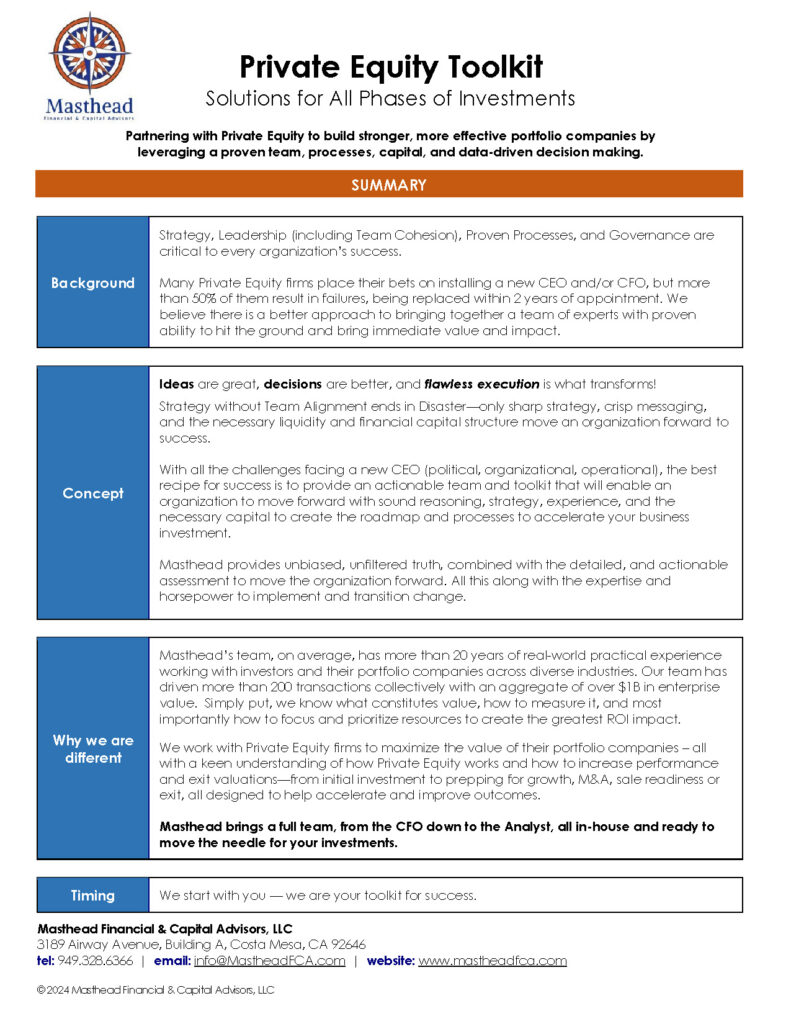
Unlocking Growth Potential: Masthead Financial & Capital Advisors’ Private Equity Service

At Masthead Financial & Capital Advisors, we offer a comprehensive toolkit to maximize your investments at every stage. Leveraging a seasoned team, established processes, substantial capital, and data-driven decision-making, we empower senior business leaders to build stronger, more effective companies.

Why Us:

  • Seasoned Expertise: With over 20 years of experience, our team has facilitated 200+ transactions totaling $1 billion in enterprise value.
  • Proven Track Record: We prioritize resources for optimal ROI, understanding what constitutes value and how to measure it effectively.
  • Full Team Integration: Our in-house team, from CFOs to analysts, is ready to drive impactful results for your investments.

Our Approach:

  • Pre-Acquisition Assessment: Beyond financial statements, we provide a comprehensive investment diagnosis, delving into key performance indicators, systems, processes, and talent.
  • Sale Readiness Preparation: We refine metrics, optimize data, and craft compelling narratives to maximize returns.
  • Post-Merger Integration: Our detailed roadmap ensures seamless integration, setting clear goals and KPIs for achieving investment objectives.
  • Scale Up/Scale Out: We optimize processes, systems, and data to enhance profitability and sustainability, facilitating scalable growth.

Deliverables:

  • Interim and Fractional Leadership: Our seasoned professionals offer leadership and guidance through transitions and performance improvements.
  • Strategic Planning: We develop actionable plans and budgets that set the stage for long-term success and growth.
  • Liquidity and Banking Resilience: Ensuring optimal liquidity and banking structures to enable focused business management.
  • Transaction Support: Holistic support for M&A, post-merger integration, and sale readiness, ensuring successful financial outcomes.

Download Our Private Equity Toolkit PDF ->>

For further inquiries, please reach out to Robert Hanger, Managing Partner, at bhanger@mastheadfca.com.

Make Your Banking Relationship Work for YOUR BUSINESS!!!

Finding the right resources to help your business be successful is IMPORTANT. Making Your Banking Relationship Work FOR YOU is critical!!! We will talk about the types of resources, how to obtain them, negotiating the best deals and how to handle tough situations when things go wrong…

– How to determine the best banking relationship for your business.
– Key Challengers in Finding the Right Resources
– Knowing what you need is half the battle…
– Understand what your Bank/Capital Provider needs from you
– How does your Business measure up?
– Negotiating the best terms that fit YOUR NEEDS
– Making sure you have cushion in your structure
– Do you have access to additional resources to help your business in the future?
– What to do when things go wrong and/or your business hits a speed bump with your relationship?
– What can the banks demand of you when things go wrong?
– How to protect YOUR business when your banking relationship shifts.